

Pro-Entropy
Just-In-Time is translating to Just-In-Case, in real-time

The world worships efficiency. The best investors and operators build for pro-entropy.
While I typically write about the micro (verticals, industries, individual business strategy), I do also follow the macro and the major trends. I’ve read The Fourth Turning many moons ago but many other folks have come out in recent times to talk about their own prognostications of similar things, mainly how we’re shifting from one era to another.
Regardless of exactly how the macro will play out, I think there are a few things that are undeniable.
Perhaps most businesses and industries have been asleep at the wheel because our world is actually full of entropy and cheap energy and heavy industrialization has made us believe that all the just-in-time products and services we get (in most of the world) is a given, not a luxury.
The Altar of Efficiency
Here’s the assumption most people don’t question: efficiency is always good.
Decades of lean manufacturing, just-in-time logistics and optimization culture have drilled this into every MBA, every earnings call, every operations review. And it’s true, up to a point. But there’s a trade-off that gets buried in the optimization math.
Every unit of efficiency you gain reduces the slack in the system. And slack is what absorbs shocks.
Think of it like this: efficiency is borrowing from your future resilience. It’s a loan that comes due when the shock arrives. And from the supply shocks of the 2020s (between the pandemic and wars), every business is now waking up to the fact that the mindset is herding from JUST-IN-TIME to JUST-IN-CASE.
Pair this with the developments in AI and the build out of the five-layer cake that Jensen Huang talks about, we’re basically daisy-chaining all our systems to rely on our grid and needing Six 9’s of reliability and availability to function. Which was where we came from, not where we should be skating to.
Perhaps this is my civil nuclear power plant engineering risk management hat on, but the reality is that (IMHO) we are dangerously over-reliant on our on-demand systems and what I call worshipping at the altar of efficiency, rather than building in resilient systems.
The Breaking Point is Match Point
Since I do believe most of us, investors, business owners, execs, heads of households even, have underinvested in resiliency, I think it’s best to talk about what the ideal state looks like and not just about how to avoid fragility (though that is a very good place to start).
The ideal is what I’ve found to be Pro-Entropy.
I’ve stolen this term from Antonio Gracias, Founder, CIO and CEO of Valor Equity Partners on Invest Like the Best who famously invested in Tesla TSLA 0.00%↑ and other Silicon Valley notables.
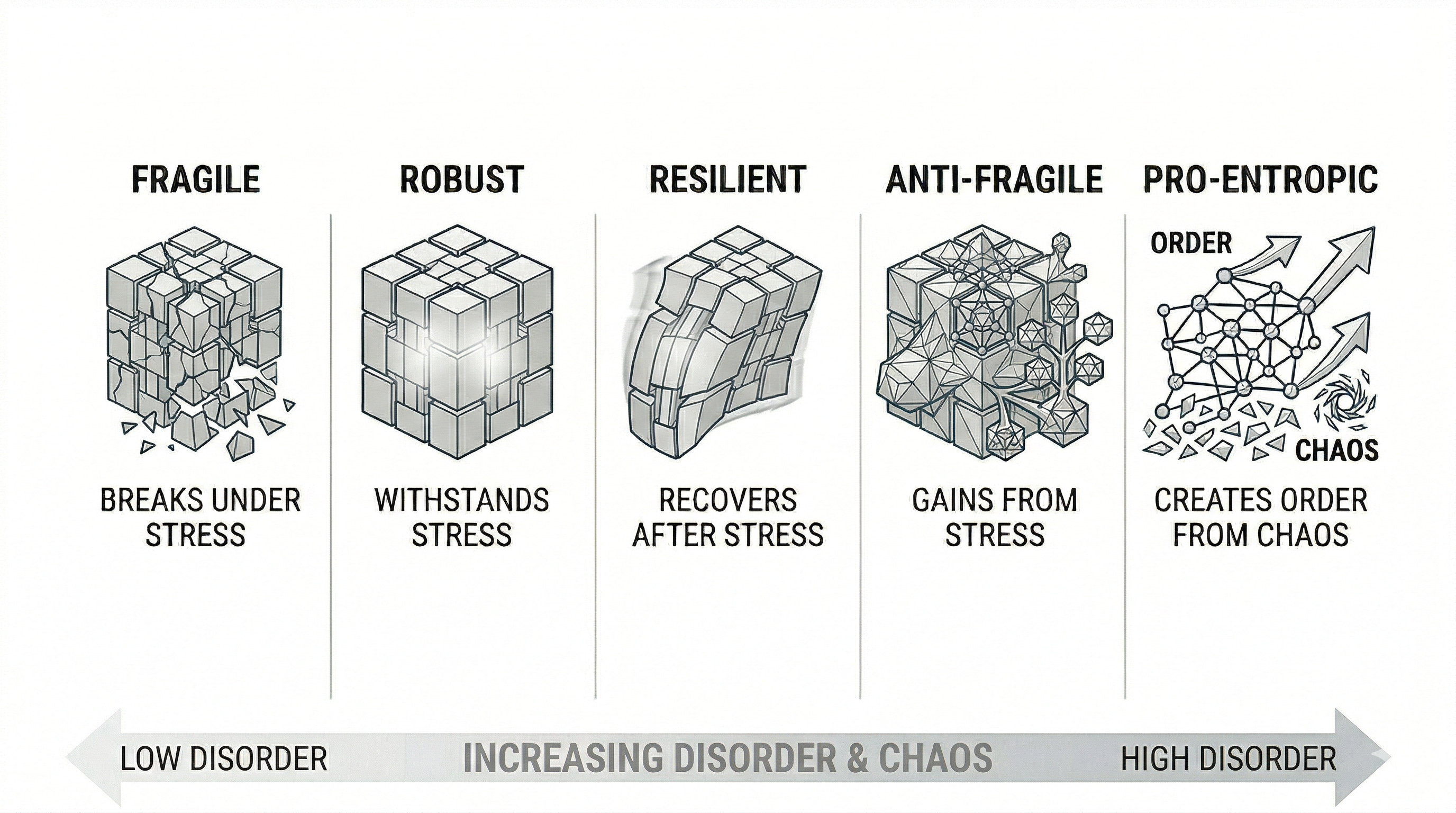
If on one end of the spectrum is Fragile (businesses, households, systems etc.), then the other end is what I think is Pro-Entropy which grows stronger from entropic destruction be it shocks, competition, loss of customers, basically any kind of loss.
Here’s what I propose as the full spectrum:
Fragile: breaks under stress
Robust: withstands stress
Resilient: recovers after stress
Anti-Fragile: gains from stress (made famous by Nassim Taleb)
Pro-Entropic: creates new order from stress
Power Laws Hold Firm
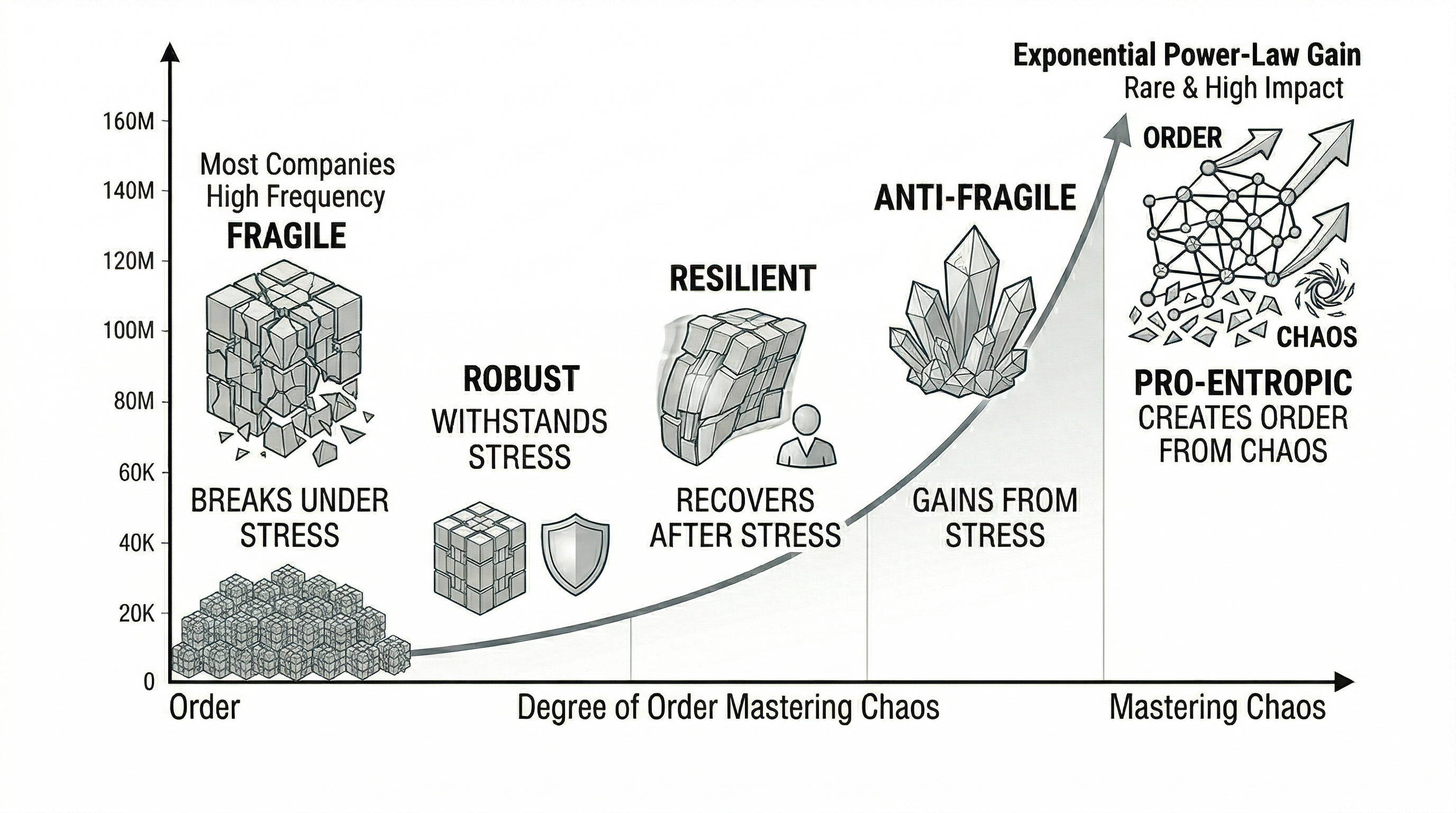
Pro-Entropy comes in many forms and if you look carefully enough, you see the best Owners, Investors, Heads of whatever are extreme preppers not because of the eventual supply shocks per se (that will of course come) but because it’s the sane thing to do to handle the downside.
More importantly, it’s one of the main “big ideas” that we borrow from Engineering: to engineer the load of a bridge to be X times what it can handle because you want to avoid all bad outcomes at all costs.
We talked about The Blind Men and the Elephant allegory before and while sometimes it is limiting, it is useful to understand a concept that is hard to capture because there are so few examples of it in real life. The Power Law is in effect here: most companies are far below and to the left. So it’s not just on a linear spectrum, it’s more on the exponential in terms of the number of businesses that are able to be aware of and actually have the economics to produce a truly pro-entropic organization.
In other words: they are few and far between.
All Models Are Just … A Proxy
Here’s another assumption worth stripping away: we think we can predict and prepare for specific risks.
Most risk management is built on the idea that you identify threats, assign probabilities and mitigate accordingly. But the most damaging events, by definition, are the ones you didn’t predict. Buffett’s “Big One” (you’ll see his quote below) may come from a “total surprise.” The NZS Capital framing is even sharper: we model the world in bell curves when the world actually runs on power laws.
The first principles reframe here is this: preparing for specific risks is fragile thinking. Preparing for any risk, building the capacity to absorb and reorganize regardless of where the shock comes from, is pro-entropic thinking. That’s the engineering load-factor principle. You don’t design a bridge for the exact weight it needs to carry. You design it for multiples of that weight because you want to survive the thing you didn’t model.
How the Best Describe Pro-Entropic Businesses
These folks say it better than I do, but I want to share the most pertinent quotes that try to get at this idea. They span leaders of Vertical Industries from Insurance, Automobiles, Software, Retail, Money Management, Aerospace, so it’s not just possible in one industry.
“[Pro-entropy] It’s a word we use here internally in our investment framework, and we think about - there are lots who use the word ‘resilient’. And to us, resilient things, resilient companies are things that recover quickly. So when you talk to neuroscientists about the word resilient, they define it as you come out of homeostasis, something happens to you, the adrenaline goes up, cortisol, whatever, and then you recover quickly, you go back to homeostasis and make a good decision. If you don’t recover quickly, then you can’t make a good decision.
Pro-entropic, as you think about a company, if a company’s resilient, it means that it recovers quickly when something happens. There’s a crisis, management’s good, they figure out a pivot, they figure out what to do. For us, pro-entropic, it really is a company that is good at chaos.”
Antonio Gracias, Founder, CIO and CEO of Valor Equity Partners on Invest Like the Best
